
About the UK Community of Practice Knowledge Production Series
This essay is part of the Liberatory Archives and Memory (LAMy) UK Community of Practice knowledge production series. Together, memory workers, artists, and archivists share reflections, research, and creative practices that reimagine archives as living, collective spaces of resistance, healing, and liberation.
By Nancy Salem
The following piece is a reflection on the cultural production of political movements encountered through the archive, the book, and the library. Conversations at the Liberatory Archives and Memory (LAMy) convenings respond to questions on how the past should be represented, accessed, and remembered. This year, I came across three archives that held visual material from historical political movements, each case raising questions of their political economy: why they were made, how they were made, and in what way they should be kept and remembered. I reflect on engaging with these archives and the questions they, and the LAMy network raise for cultural practitioners, organisers, and memory workers, particularly in light of new technologies and digital practices.
Atelier Populaire, Paris (1968)
In May 1968, a group of artists formed the Atelier Populaire, Popular Workshop, to produce visual material as part of the now infamous student and worker strikes. I choose the words — part of — carefully. It has become my shorthand to say that posters like those created by the Atelier (Image 1) were made in support of movements. But the word support introduces a distance between the material and the movement that the group would likely object to. The production of the posters reflected a process: “the radical students and artists re-examine their points of view by allying with the workers.” It was a chance to rethink ideas about individual artistic creation to what it means to produce together, “projects for posters worked out in common after a political analysis of the day’s events or after discussions at the factory gates…” Through the visual, the students and artists inquired, is this political idea sound?
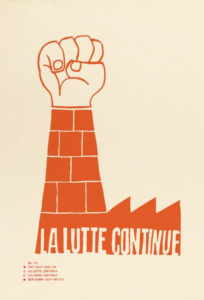
In compiling texts and posters from ‘68, the Atelier wrote a note to readers that the posters were not for decorative purposes, for display in cultural institutions, or even for historical evidence; not an outcome or outside of the protest. They hoped instead that bringing together the posters in a publication that would inevitably end up in libraries and archives would serve as “inducement for finding,” forging “new levels of action both on the cultural and the political plane.” Not record, but encouragement. The posters’ rightful place was the centre of movements where they are forged, the streets and walls of factories, the note reads, but bound together in a book they appeared in stasis, waiting for their return.
There is something very striking about how the production of these posters was described as tightly interwoven in the daily routine of the commune, as a means to think through its activities. Their production represented something that communicated inwards as well as outwards. I begin to think more concretely about the process of production, a thought that carries to the next archives I explored.
Silkscreen Training Project, Johannesburg (1964)
In the Mayibuye Archives in Capetown is another book of movement posters, Images of Defiance: South African Resistance Posters in the 1980s that charts the history of 300 images of popular resistance. Image 2 represents the poster South African Scooter Drivers Union printed in 1984, remembering the history of independent trade unions in the South African liberation movement. The editors in this book refer to the posters as “reflections of a people and a fight” that also recall a process. The poster was printed by the Silkscreen Training Project (STP) founded in Johannesburg, conceived around workshops for activists to produce their own print media, and simply a facility to print material. The STP would handprint posters using a silkpress, sometimes images and sometimes just information.
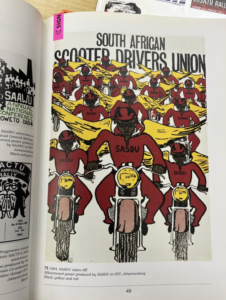
The posters from that period can be accessed as part of a Virtual Exhibition using material from the South African History Archive, with excerpts of the book that highlight the history of the press: “Silkscreening allowed for full participation by the newly recruited membership of UDF [United Democratic Front] organisations, involving up to 20 people at a time in preparation and printing. The process permitted short ‘runs’ at relatively low cost, which proved perfect for publicising hundreds of local meetings and activities. This history would go on to include wrecked and confiscated machines and the detaining of workers that eventually led them to go underground.
A theme was beginning to emerge in my engagement with this material, that was very much concerned with the ability of people to create their own material. In some ways, it reminded me of the discourse around the early days of social media, the ability for anyone with an internet connection to create, share, and connect. While ideas around the egalitarian ‘free’ nature of social media platforms (we pay three-fold with our data) have muted, some of these connotations seem to remain, that we are somehow connected and able to produce. But these projects had a very different imagination of what it means to own the means to produce media and its circulation. This led me to a slightly different case study, not a reflection on the posters and the politics they produce, but a reflection on a plan.
The Lucas Plan, sites across the United Kingdom (1976)
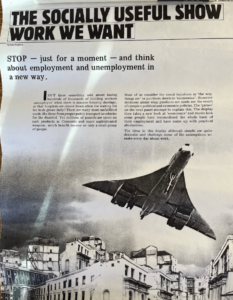
In 1976, workers across seventeen Lucas Aerospace sites in the U.K organised to propose an Alternative Corporate Plan. Facing massive job losses due to automation, offshoring, and defence budget cuts (almost half of their production went to military contracts) workers (organised together as a Combine) developed a plan to produce socially useful products. It was absurd, the workers wrote, that they were out of a job when they could produce urgently needed machines for other sectors. If governments could buy arms from Lucas Aerospace, why couldn’t they buy medical equipment? It was their right to produce products that are constructive to their communities, work they want. Today, the Mayday Room Archives in London holds a large amount of newsletters, meeting minutes, newspaper cuttings, and exhibitions and campaign materials from the Combine.
They remain as inducements, as the Atelier Populaire suggested, to think again about what else our work could do. They also represent, from a different lens, what it means to produce our own representations of the world, its possibilities, and futures.
Concluding Thoughts
The push to write this post came, somewhat paradoxically, from my research on Generative AI and production. I have been thinking about what often seems like discursive misdirection: questions about measuring, capturing, and identifying AI creativity, the capacities of new technologies to augment, make more efficient, and speed up production. It does not always seem clear to me that we need to entertain the questions of whether AI is creative at all. These technologies are the result of exploitative systems that require massive amounts of precarious human labour and natural resources. If we reflect on the questions of these archives, what creative process could result from these algorithms? The groups that produced the materials explored in this piece speak powerfully about what it means to produce, what happens and what is contained in the material process of production, and what cultural production is for. Conversations at the LAMy convening and within the community of practice are so often concerned with these fundamental questions, amidst much misdirection.
About the author
Nancy Salem is a final-year doctoral candidate at the Oxford Internet Institute, University of Oxford. Her research examines how emerging technologies are constructed, represented, and contested, informed by approaches in cultural studies, political economy, and new media studies.