
By: Victoria Lu
I have these moments when I know that I’m in a particularly special period in my life. I know that what’s unfolding in front of me is almost magical and something I can’t return to once this short time ends. Can I call it some sort of pre-nostalgia? That is how I felt over the two weeks that I spent in Nairobi, Kenya. Upon arriving in Nairobi, I went straight to Mathare Social Justice Center (MSJC), where I was introduced to the wonderful staff and community members who make up that collective space. Mathare is one of the largest informal settlements in Nairobi, home to 500,000 people. It is a difficult place to live in, without regular access to running water and electricity. As if the material conditions weren’t devastating enough, Mathare faces immense state violence that manifests in the Kenyan police state targeting young people in Mathare in extrajudicial kidnappings and killings. A report named “They were Us,” released in 2021, detailed the personal loss of many of Mathare’s residents who’ve had their loved ones senselessly murdered. One of those residents was a woman named Mama Victor, who lost two of her sons to Victor and Bernard to police executions in 2017. She became active in the Center, becoming a formidable activist and a part of the Mothers of Victims and Survivors Network. Just seven years later, in 2024, she died in severe floods that devastated Mathare. Intentional, deadly state neglect stole her life and the lives of her sons; they should all be alive right now. Mama Victor’s life is only one piece of a larger, painful mosaic that makes up many lives in Mathare.
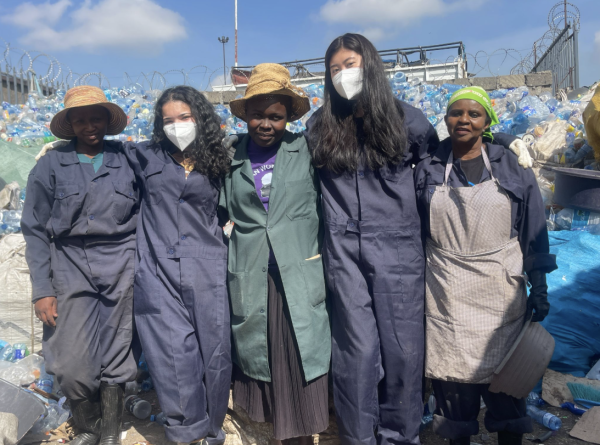
Throughout the two weeks, I spent most of my time with MSJC’S Dhobi Wastepickers and Domestic Workers Cooperative. One early Wednesday morning, I walked over to the back of the Center, where masses of pre-sorted plastic bottles were propped against the wall. In the midst of the blue bottles, I could see two of the MSJC’s wastepickers, Ruth and Amy. Both women were bent over large burlap sacks, shoveling, scooping, and prodding hundreds of bottles into the sacks. I arrived asking to help them, and soon enough I was given the simple task of holding the burlap sacks open while they filled them. Once they were filled, I was told to drag them towards a truck parked nearby. For about three hours we developed this routine—open, fill, drag. Soon enough, the truck was filled to its brim, signalling the transition for drop-off. Off we went, about thirty minutes from the center to deliver the first load at Mr. Green’s plastic collection and processing site.
The following day, I tagged along with a few of the center’s interns for a field day at Dandora Landfill—the largest landfill in East and Central Africa. We were connected to the cooperative, Dandora Green, whose lead, Sam, took us on what he described as a “hike on mountains of garbage”. What stretched before us could only be described as dystopian. Trash stretched out for miles, while towering piles hovered above us. To our left, a small fire of trash burned, while clouds of methane emitted from nearly fourty years of compressed trash climbed steadily into the air. On my right, I could make out a primary school and heard the sounds of children playing outside. Children whose proximity to the landfill poisons their bodies with severe respiratory issues. Children who— in a few years, with limited economic opportunities—might find themselves on the other side of the school, working grueling, twelve-hour shifts in the landfill.
We spent nearly three hours walking through the landfill, learning about its 40-year history. Sam and Michael from Dandora Green shared their stories with us, while we talked about ways to continue to connect our two worlds, New York and Nairobi. Sam has a goal of disseminating the work that Dandora Green does to the wider world, and I was keen to connect him to the labor school to help him do so. Dandora Green provides their cooperative members with fairer selling prices, medical healthcare, and creative recycling and repurposing programs. Sam introduced us to a few workers who we had short conversations. To be completely honest, those conversations felt a little awkward for me; I was uncomfortably aware of the power dynamic that existed, as a visitor versus a worker. Even in our appearances, the three of us in clean clothing, myself in white, while the workers were mostly dressed in black, stained with hard labor. A young worker we approached kept exclaiming how beautiful Maya and I were; she was so kind and filled with energy. Her eyes only dimmed when she briefly mentioned that she was young, 19 years old, present at the landfill with no other choice. At that moment, a sudden gust of wind picked up, lifting the trash into the air, colorful plastic bags circling above us. Reminding me of confetti, it was almost pretty, if it wasn’t for how horrific the circumstances were. This is the reality of capitalism, of unrestrained consumption, of workers young and old who live on their feet and die on their knees to drive our world order forward.
Dandora Green’s Cooperative operates within the landfill, working to memorialize and cement into public memory the material conditions of waste-pickers’ livelihoods. I find that one of their cooperative initiatives of upcycling glass bottles into reusable vases, glasses, and containers particularly interesting. When someone purchases one of those items (which I also did lol) and places it in their home, that object carries a living memory of its own life cycle. The consumer is forced to remember that this item was made by a worker, under extremely exploitative and dangerous working conditions in a landfill, where other items in that same house might end up. How ironic and almost peculiar that this object most likely came from the Global North, discarded in the Global South, then returned to the Global North?
This is the reality of capitalism, of unrestrained consumption, of workers young and old who live on their feet and die on their knees to drive our world order forward.
I often think about how we handle worlds of pain, no, rather a universe’s worth of pain. I think it’s unnatural how painful this world is, and the only way we can truly combat it is through communal resistance. I mean that in every form, we need to gather to heal, we need to fight, and build. I was reminded of that during a Kenyan Left Alliance meeting I participated in through a connection Whose Knowledge? had with an activist based in Nairobi. Following the meeting, they also accompanied me to a radical library called Uzkombozi Library, where I spent hours speaking to one of the founding members. He was a shy, soft-spoken man who patiently explained the founding of the library, different Pan-African revolutionaries, and the archival work that they recently started undertaking. I mentioned to him that I was working on a project, mapping out community archives around the Global South, and would love to include the library. We exchanged information, both excited to see where this connection could evolve.
My last day in Nairobi perhaps revealed the function of artivism in memory work. Across Mathare is the Dhobi Women’s Community Park, a gender-based violence memorial park that serves as a site of living memory. Previously a dumpsite, the domestic women’s cooperative began to plant trees and plants in therapeutic commemoration of painful trauma and loss. Metaphorically and physically, the plants are buried into the ground, firmly rooted and able to sprout into a new life, much like the women who’ve overcome horrific circumstances of workplace gender-based violence. Later that night, I attended a screening regarding the evolution of Kenya’s protest music in the context of their social movement history. Most of the songs were in Kiswahili, and although I did not grasp the literal translations, it was undeniable that music helped preserve the memories of Kenya’s ongoing resistance movements. Music has also helped to preserve the memories of social traumas that still haunt the nation’s young history. The night ended with a corresponding panel with several artists from Kenya; one of them, a singer, sang a hearty rendition of “Unbwogable” by Gidi Gidi Maji Maji, the audience standing up, clapping and stomping their feet as we collectively sang “ We are ready for revolution, we are ready”!
Victoria Lu is a labor organizer and activist born and raised in Queens, New York. Victoria is a Jeannette K. Watson and Moynihan Public Service Fellow 2026. Through these formative fellowships, she has had the privilege of working in solidarity with social movements across Australia, New Zealand, Spain, and Kenya. Her most recent experiences involve spearheading union-worker cooperative cooperation at the Writers Guild of America East. Victoria is a Master’s student of Labor Studies with the CUNY School of Urban and Labor Studies. Before joining the New York City Urban Fellows program in the Fall, she’ll be based in Malaysia with Whose Knowledge?.