
About the UK Community of Practice Knowledge Production Series
This essay is part of the Liberatory Archives and Memory (LAMy) UK Community of Practice knowledge production series. Together, memory workers, artists, and archivists share reflections, research, and creative practices that reimagine archives as
living, collective spaces of resistance, healing, and liberation.
By Marcia Michael
A Voice Unfolding
Through my creative practice, I challenge the presence—and often absence—of the Black subject within the family album by constructing, using photography as my exploration point, an archive of reclamation. Drawing on series such as The Study of Kin and The Family Album (2009), The Object of My Gaze, which began in 2015 where I photographed my mother and myself, became the basis of my PhD research. This intergenerational visuality enabled me to engage in a black feminist discourse of memory, and African diasporic traditions, where I reimagined and restructured history through the empowered, political, and self-loving Black body.
Matrilineal Roots: When and Why My Mother Became Central
My mother’s stories formed the backbone of my understanding of myself as an artist and my practice. I absorbed the fragments of laughter, grief, and resilience. Over time, I recognised that these narratives carried the weight of histories denied by dominant accounts. My interest in my matrilineal history crystallised when I witnessed how my mother’s body and voice awakened my sense of belonging and presence: she taught me not only family names, but gestures of being and knowing. In photographing her, I learned a methodology that, through research, I understood as Black Matrilineage. My camera became a tool to recover fragments as “rememories” that reside in the body and mind. I came to see my mother’s body as an archive: a vessel through which multiple histories speak. This realisation transformed my practice. The question “How do I speak what has been unspeakable?” became central. I questioned how, through a Black Matrilineage, the transmission of histories from mothers to daughters of the past can be both a methodology and a manifesto.
Visual Acts of Recovery: Photography and Poetic Witnessing
Photography became an act of refusal and re-embodiment, a space where past and present collapsed. Repeated poses and gestures blurred temporal boundaries, revealing what Toni Morrison (1994) calls “rememory,” a thought picture that emerges across generations. I do not apologise for confronting painful truths; rather, I invite viewers to witness: to hear echoes of ancestral voices and feel the tension between what history has obscured and what surfaces through our flesh-to-flesh connection.
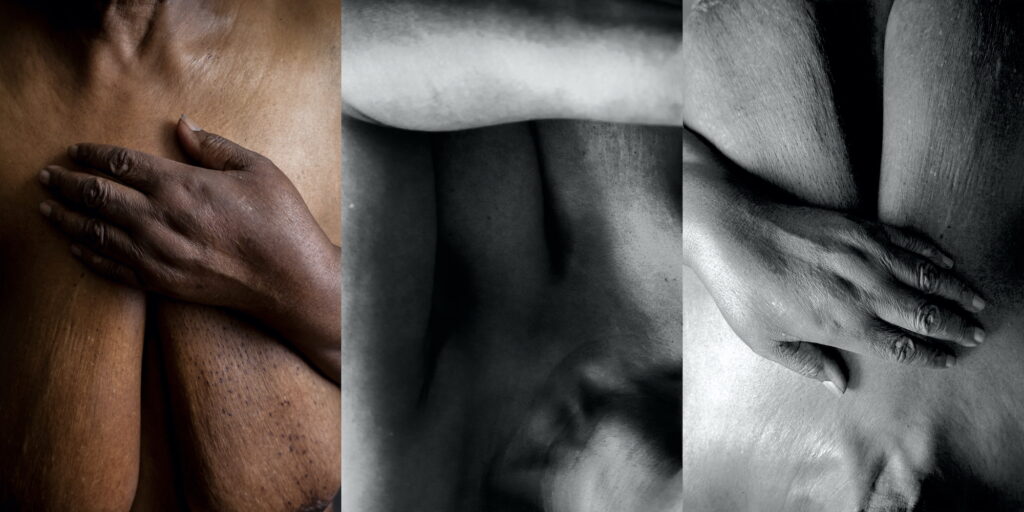
Extending into various media, each offering another layer of the story, I wrote to hear histories of refusal, ways of knowing that resist erasure. These offerings ask: how might our cultural memories intertwine, and how might we, together, re-narrate a world that has long silenced certain voices?
Presenting at LAMy Brighton
At the LAMy Brighton convening, I presented work grounded in matrilineal voice. I offered voices waiting to be remembered, I positioned myself to echo (hi)stories. In return, I felt the potency of collective witnessing: shared attention affirming each story. As I spoke, I made eye contact with each practitioner, singular connections forming a circle of solidarity. This reminded me that individual recovery is entwined with communal solidarity: when one voice rises, it supports many others.
Centring My Mother’s History: The Power of poetry and presence
I read My History, Breathe and Listen, from My History is in Her(e), (2022), from the series The Object of My Gaze (2015-2025).
The first, an introduction, My History, was presented as a means to explain my birth story. The title of the next poem was poised to deliver a poignant response to the last sentence of the first poem, allowing the audience to take a breath, to believe my questioning of my mother’s experience of having me. I spoke with honesty. The last poem, Listen is where I urged from a place of vulnerability the need to be heard. At times, I paused and repeated questions, extending the sense of endurance that Black histories carry, whilst directing my gaze at an individual. This was important. It had to be a person and not just space.
I used gestures to emphasise the connection of embodied experiences. Extending words not on the page, holding eye contact, and believing that shared silences (tied by an invisible thread that I had drawn with my breath and my history) underscore that recovery happens in a community.
I offer a sample of the three poems.
My History
Mother
She gave birth to me.
She birthed
me
no!
I was pulled, yanked out of the trapped furnace of her,
she gave birth to me.
(the last line)
I am sure that in the past, in her history she was happy.
Breathe
Why do the silenced remain silent?
When they have voices to be heard.voices.to.shake.the.nations.
and.narratives.to
perform, receive, return and retrieve.
Why do the silenced – hmm?
Why do I remain silent?
Listen
I have decided that the time for you to hear my story is now.
No more waiting
no more fear
no more thinking that time will correct the past,
without my voice.
I am concerned for the new voices silenced by this master narrative.
Reflections on Presenting at LAMy Brighton
As I spoke these matrilineal stories, I wondered how comfortably witnesses sat. These narratives can unsettle, while beckoning deeper empathy and collective responsibility. Though I spoke without images, the visual act of mother-daughter matrilineage permitted these words to manifest. At the convention, feminist discourse emerged as a theory of recovery: considering what one might reclaim in an embodied family archive to understand self, family, collective, and culture.
I hoped that this offering would enable them, in their own way, to become part of a conversation that would dismantle patriarchal narratives and re-embody marginalised pasts. To understand oneself, family, collective and culture.
My practice is my testimony.
Dr Marcia Michael is an artist of Caribbean and African heritage, born in the UK. Her multidisciplinary practice centres and extends from photography. Michael challenges the presence of the black subject within the auspices of the family album by constructing an archive of family reclamation through her practice. www.marciaichael.co.uk